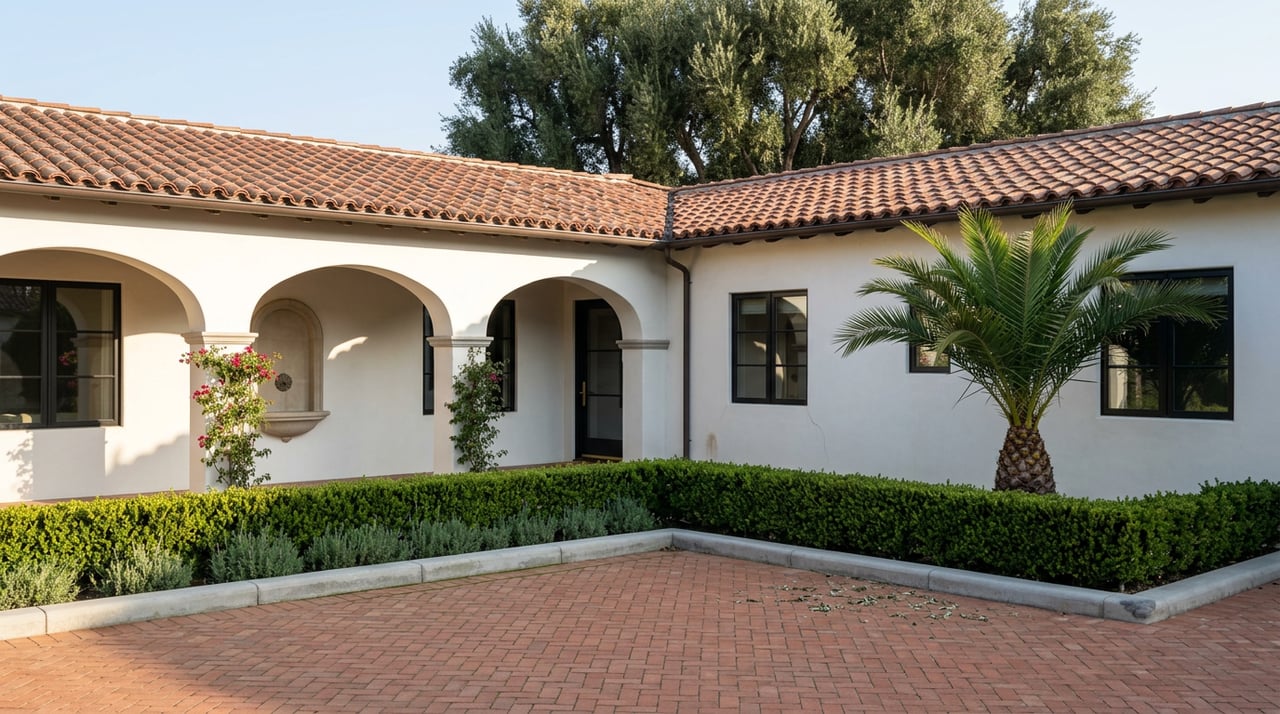
Two buyers close on architecturally matched homes in the Covenant this year. Same floor plan, same lot size, same fencing and roofline the Art Jury approved decades ago. Six months later, one owner's monthly Association bill is nearly triple the other's. Neither made a mistake. Neither is being overcharged. The Rancho Santa Fe Association simply doesn't set dues the way every other California HOA does, and that difference is the number a median-price search will never show a buyer comparing the Covenant to somewhere like Point Loma or La Jolla.
Most homeowners associations charge every member the same flat amount, or scale it to something fixed like square footage or lot size. The Rancho Santa Fe Association does neither. It assesses dues as a percentage of your home's county-assessed value. In its most recently published budget, covering fiscal year 2026, the Association set that rate at $0.15 per $100 of assessed value, or 0.15 percent, against roughly 2,044 member properties. Compare that to the roughly 1 percent of assessed value you already pay in property tax, and the Association's cut looks small. But because it rides on the same assessed-value base as your tax bill, it inherits the same quirk that makes California property tax so uneven between neighbors: Proposition 13.
The Formula Nobody Mentions on the Listing Sheet
Prop 13 caps how fast a home's assessed value can rise for an owner who stays put, typically around 2 percent a year, regardless of what the market does. A house bought in 2004 might carry an assessed value a fraction of its current market price. The same house, sold today, resets to something close to the actual purchase price. That's true of every property in California. What's unusual about Rancho Santa Fe is that this same assessed-value gap doesn't just show up on the tax bill. It shows up again, every month, on the HOA statement.
Picture two neighbors in the Covenant, both in comparable homes, one who bought in the early 2000s and one who closed this year. The long-tenured owner's assessed value has crept up slowly under the Prop 13 cap. The recent buyer's assessed value reset to a current market price that could be several times higher. Both pay the same 0.15 percent rate. Only one of them is paying it on a much larger number.
Run the actual math on the fiscal 2026 rate and the gap becomes concrete. An assessed value of $2 million works out to about $3,000 a year, or $250 a month, in Association dues. An assessed value of $5.5 million, which is not unusual for a recent purchase in the Covenant, works out to about $8,250 a year, or roughly $688 a month. Same rate, same governing documents, nearly a three-to-one difference in the bill, driven entirely by purchase timing rather than anything about the house itself.
That's the number worth asking about before you write an offer. The systemwide average across all member properties lands around $408 a month, but an average built from decades of Prop 13 compression tells a new buyer very little about what they'll actually pay. A buyer closing in 2026 should expect to sit above that average, not at it, because their assessed value starts at today's price rather than some earlier decade's.
What That Money Actually Funds
The Association's fiscal 2026 budget runs about $33 million, with roughly $10 million of that coming from member assessments and the rest from club memberships and user fees at the Golf Club, Tennis Club, and Osuna Ranch, which are largely self-funded rather than subsidized by dues. The assessment dollars cover the parts of Covenant life that don't generate their own revenue: the roughly 60 miles of private trails, the Association's own security patrol, parks and open space, and the enforcement side of the Protective Covenant itself, carried out through the Art Jury.
That last piece matters more to a buyer than it sounds. The Art Jury is the design review board that has to sign off on new construction, major remodels, guesthouses, pools, fencing, and grading before you can build it. The Association overhauled how that process works in 2026, moving submissions onto a new online system called Accela with a published 2026 submittal schedule, which replaces what used to be a paper-heavy process with a member login and digital tracking. If you're buying with renovation plans already in mind, budget for that review as its own line item, both in time and in the cost of preparing plans, elevations, and material samples before you can break ground.
The Comparison a Median Price Hides
Here's where the Covenant's dues structure becomes genuinely useful information rather than trivia. Not every gated community inside greater Rancho Santa Fe works this way. The Bridges, organized around its own private golf club with roughly 240 residences on about 540 acres, and enclaves built around The Farms Golf Club run their own separate HOA and club dues structures, typically closer to the flat-fee model most Californians expect. A buyer comparing a Covenant estate to a home in one of these adjacent gated communities isn't just comparing lot sizes and architectural style. They're comparing two entirely different logics for what their monthly carrying cost will be and how predictable it is over time.
For a buyer who plans to stay decades, the Covenant's model eventually works in their favor, the same way Prop 13 does on the tax bill. For a buyer who expects to sell in five to seven years, or who is comparing total cost of ownership against a flat-fee alternative, the math looks different from day one. Either way, it's a conversation worth having before escrow, not after the first Association statement arrives.
What to Ask Before You Write an Offer
A few questions turn this from an abstraction into a number you can actually use:
- What is the property's current county-assessed value, and how does that compare to the purchase price you're about to pay?
- Has the Association's assessment rate changed in the most recent budget cycle, and where can you review the current fee and fine schedule directly on the Association's site?
- If you're planning any exterior work, has a prior owner already secured Art Jury approvals, and do the as-built drawings match what's actually on the property?
- Are there recent board minutes referencing planned special assessments or major capital projects that could change the number next year?
None of these questions show up in a median sale price. All of them show up in the numbers that determine what you'll actually write a check for every month.
A Few Quick Questions
Does the Rancho Santa Fe Association dues structure apply to every property inside the Covenant? Yes, the percentage-of-assessed-value assessment applies to the roughly 2,044 HOA member properties within the Covenant boundary. Gated communities outside that boundary, including The Bridges and enclaves around The Farms Golf Club, operate under separate HOA and club structures.
Will my Association dues go up every year the same way my property tax does? The Association sets its rate annually as part of its budget process, and the underlying assessed value moves under the same Prop 13 rules that govern your property tax. The rate itself is not fixed permanently, so it's worth checking the current fiscal year's figure directly with the Association rather than assuming last year's number holds.
Does the Art Jury review process apply to routine maintenance, or only new construction? Expect review for new construction, major remodels, guesthouses, ADUs, pools, fencing and gates, grading, and significant grounds changes. Routine maintenance that doesn't alter the exterior generally does not require a new submission, but any exterior change is worth checking against the Association's current guidelines before you assume it's exempt.
If you're weighing a Covenant property against another North County or coastal San Diego option and want the real math run on a specific address before you make an offer, Trinton Hurt can walk through the assessed-value picture, the Art Jury history on a given property, and how the numbers compare to what you'd carry elsewhere. Let's Connect.